
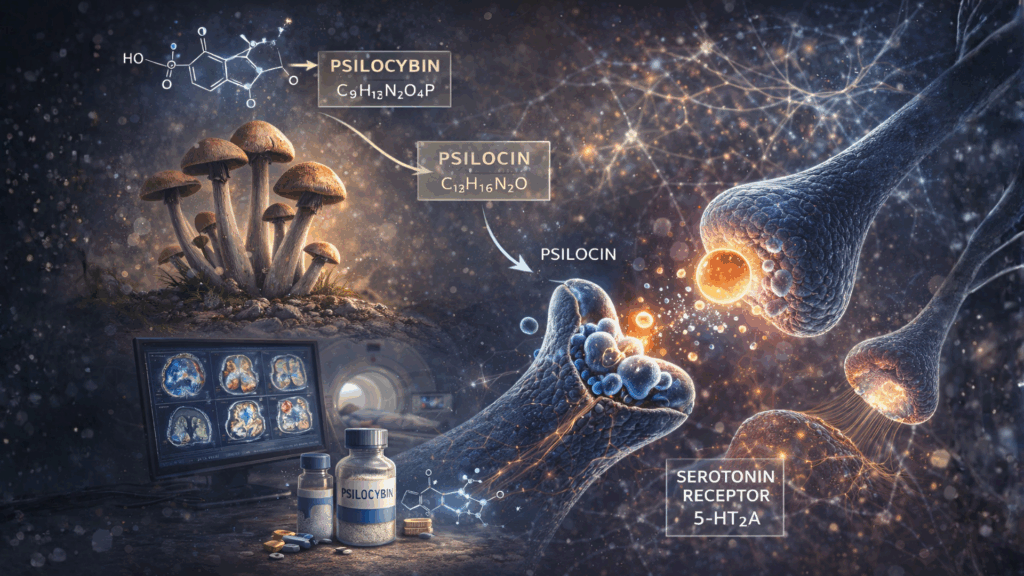
Psilocybin’s effects in the brain are closely tied to how it interacts with serotonin, a neurotransmitter involved in mood, perception, learning, and cognition. After psilocybin is converted into psilocin in the body, it binds primarily to serotonin receptors, with the strongest activity observed at the 5-HT2A receptor. Scientists consider this receptor interaction central to understanding psychedelic effects (National Institute on Drug Abuse).
Serotonin receptors act like signaling switches on brain cells. When psilocin activates the 5-HT2A receptor, it changes how neurons communicate with one another. Research published in Nature Reviews Neuroscience explains that this receptor plays a key role in perception, attention, and higher-order thinking, which helps explain why psilocybin alters sensory processing and thought patterns in controlled studies (Nature Reviews Neuroscience).
Laboratory and brain imaging studies show that 5-HT2A receptors are densely located in the cerebral cortex, particularly in areas involved in decision-making and self-awareness. When these receptors are activated, normal filtering of sensory and internal information becomes less rigid. According to research summarized by the National Institutes of Health, this change allows more signals to pass between brain regions, contributing to altered perception and cognition (National Institutes of Health).
Importantly, scientists emphasize that serotonin receptor activation under psilocybin is temporary. Once psilocin leaves the body, receptor activity returns to baseline levels. A peer-reviewed study in Nature Communications found that psilocybin does not permanently alter serotonin receptors or damage brain cells, reinforcing that observed changes are functional rather than structural (Nature Communications).
Researchers also caution that serotonin signaling is complex and varies between individuals. Differences in genetics, brain chemistry, mental health history, and medications can influence how strongly receptors respond. This variability is one reason why clinical trials include extensive screening and why results cannot be generalized to unsupervised settings (U.S. Food and Drug Administration).
High Science® presents serotonin receptor science to help readers understand how plant-derived compounds interact with the brain at a molecular level. By focusing on verified neuroscience rather than speculation, this educational approach supports informed discussion about emerging research while recognizing its limits.
SOURCES
National Institute on Drug Abuse – Psilocybin and serotonin
Nature Reviews Neuroscience – 5-HT2A receptor overview
National Institutes of Health – Psychedelics and brain signaling
Nature Communications – Serotonin receptor signaling and connectivity
U.S. Food and Drug Administration – Drug research standards
All information presented is for educational purposes only and focuses on plant science research and emerging studies. This content does not replace professional medical advice. Always consult licensed healthcare providers or trained professionals in plant-based science and natural health disciplines. All information provided is thought to be put to date with modern research and you should still do your own research and consult with professionals.