
Safety is a central focus of all modern psilocybin research. While scientific interest in psilocybin has increased, researchers consistently stress that the compound carries risks and must be studied under controlled conditions. Public health agencies emphasize that understanding potential harms is just as important as understanding potential outcomes (National Institute on Drug Abuse).
One of the primary risks associated with psilocybin involves psychological distress. During research sessions, participants may experience temporary anxiety, confusion, fear, or emotional discomfort. Although these reactions are usually short-lived in clinical settings, they can be intense. This is why studies include trained professionals who monitor participants and intervene if distress becomes overwhelming (National Institute of Mental Health).
Another key safety concern is the risk of adverse reactions in individuals with certain mental health conditions. Clinical trials routinely exclude participants with a history of psychotic disorders, bipolar disorder, or severe personality disorders. Research has shown that psilocybin can exacerbate underlying psychiatric vulnerabilities, which is why screening is considered essential rather than optional (National Institute on Drug Abuse).
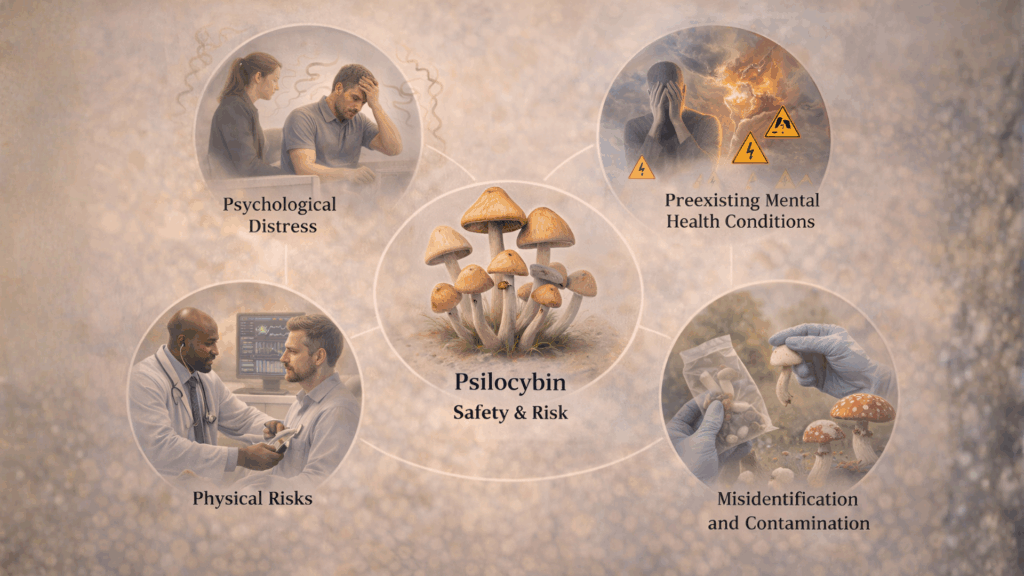
Physiological risks are generally considered lower than psychological risks in controlled studies, but they are still monitored. Psilocybin can cause temporary increases in heart rate and blood pressure. For this reason, researchers evaluate cardiovascular health and monitor vital signs during sessions. The U.S. Food and Drug Administration notes that these precautions are standard for investigational compounds that affect the central nervous system (U.S. Food and Drug Administration).
Misidentification and contamination present additional risks outside research environments. Public health agencies warn that many toxic mushroom species closely resemble psilocybin-containing mushrooms. Accidental ingestion of poisonous mushrooms can result in serious injury or death. The Centers for Disease Control and Prevention has documented cases of mushroom poisoning related to misidentification (Centers for Disease Control and Prevention).
Researchers also caution against assuming that positive outcomes reported in studies apply broadly. Clinical trials involve preparation, supervision, and follow-up that significantly reduce risk. The National Institute of Mental Health emphasizes that removing these safeguards increases unpredictability and potential harm (National Institute of Mental Health).
High Science® presents safety and harm reduction research to support responsible education and informed public discussion. By highlighting risks alongside research findings, this approach reinforces the importance of evidence-based policy, ethical standards, and public health considerations in emerging plant science.
SOURCES
National Institute on Drug Abuse – Psilocybin safety overview
National Institute of Mental Health – Clinical research participation and risk
U.S. Food and Drug Administration – Investigational drug safety
Centers for Disease Control and Prevention – Mushroom poisoning and safety
All information presented is for educational purposes only and focuses on plant science research and emerging studies. This content does not replace professional medical advice. Always consult licensed healthcare providers or trained professionals in plant-based science and natural health disciplines. All information provided is thought to be put to date with modern research and you should still do your own research and consult with professionals.